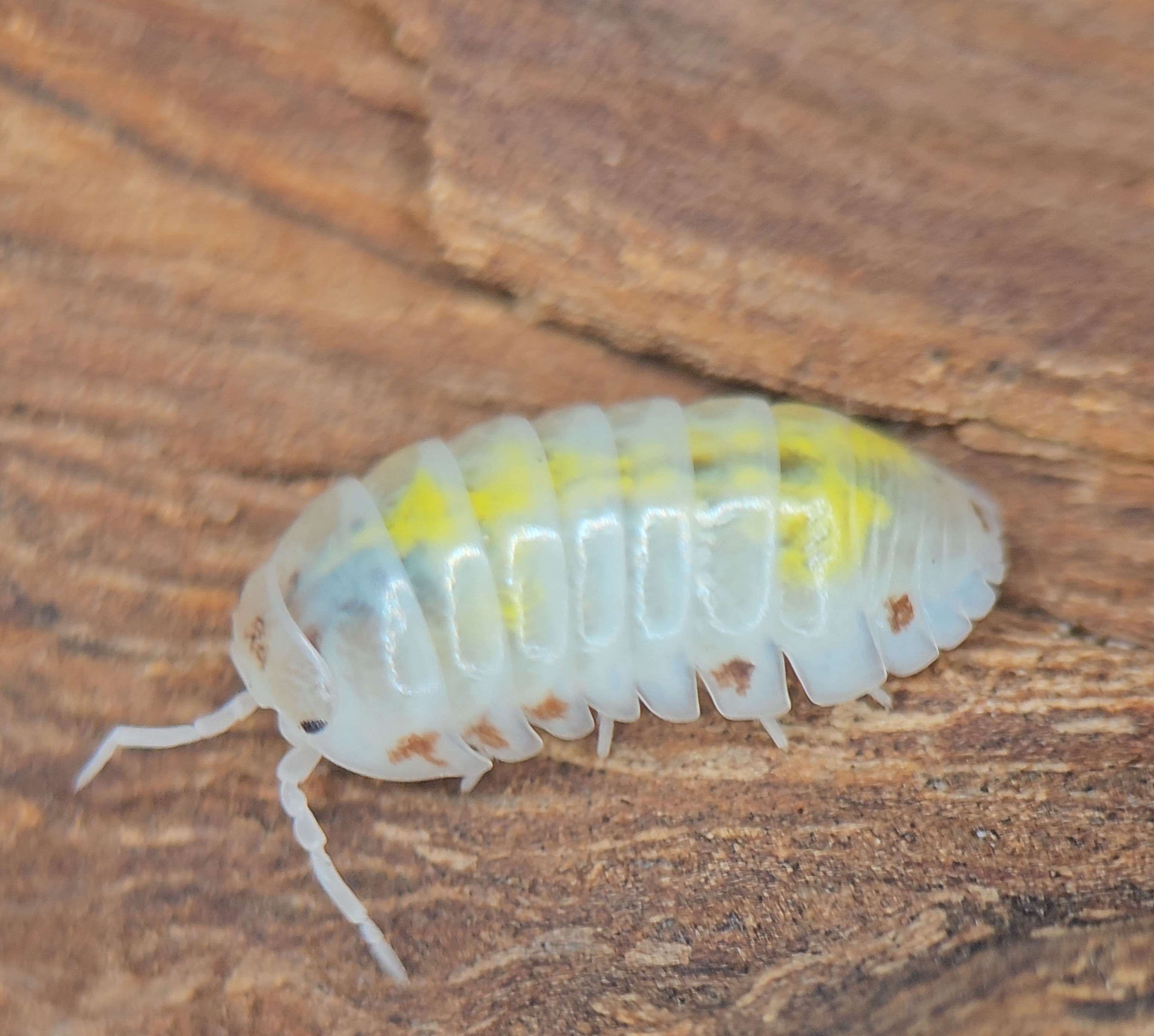

Armadillidium vulgare "American Magic Potion"
Armadillidium vulgare "American Magic Potion" isopods for sale!
You might be asking, what are the differences between the American and Japanese lines of vulgare magic potion? Well, I'm here to break it down for you.
The Japanese line originates in Japan. They are a tad smaller than the American line but are more prolific breeders. They have smaller black spots but express more of that beautiful yellow splotching/swirlies.
Vulgare magic potion get rather large, reaching about 2+ cm at adult size and can take over 3 years to fully mature. They naturally have yellow spotting/swirlies in the wild, making magic potion the dalmatian gene. They are more nocturnal but can be day active, they do like to burrow but when they are top active, they can usually be found in the leaves or on top of their bark versus being under it. They are easy to care for, have mid to large size broods, prefer a semi-arid environment with about a 50/50 wet to dry gradient. The vulgare magic potions are one of the most popular isopods in the hobby and for many good reasons. They are a must have for any collection and can also serve as a great colorful clean up crew as well since they are excellent at breaking down organic matter, leaves, rot wood and manure.
Origin: North America
Humidity: Semi-arid
Ventilation: Moderate (See our ventilation guide in the isopod care sheet under the "Care Sheets" tab.)
Housing and Care: A 6 quart shoe box or similar is sufficient to start a 10 count culture in and get established, and then will need to be moved to a larger enclosure once their population outgrows it. Provide a moisture gradient of about 50% moist and 50% dry. Use sphagnum moss on one end of the enclosure to help retain moisture between spraying (frequency of spraying will depend on amount of ventilation you provide and atmospheric conditions, just as long as the moss is always kept moist. Aim to spray down the sizes and make sure the water is reaching the bottom layer to make it last longer), a couple inches of substrate is sufficient, add a good amount of leaf litter, a hide such as cork bark or edible hardwood bark or both, a calcium source such as a cuttlefish bone, eggshell or calcium powder is a healthy addition for all isopod species. Rotting wood is also highly encouraged as well. You can supplementally feed them once a week with a small piece of sweet potato, carrot or squash and a protein source such as our own Bug Buffet Haus Blend, fish flakes, freeze dried shrimp/minnows or other commercialized isopod diet (small enough amount that they can consume it within 2 days to help minimize mites and mold.